Product
Governance that runs on every inference.
Every AI decision is judged against the policy that governs the workflow it belongs to. Setup, live operation, and the human checkpoints in between. What an assessor gets is a verdict and the control behind it. Not a log to interpret.
Posture
Setup & configuration governance
Governance starts at the workflow, before the first inference. The workflow is declared once. The agents, the tasks, the tools those tasks need, the policy, the risk tier, and an owner. Configuration is judged against that.
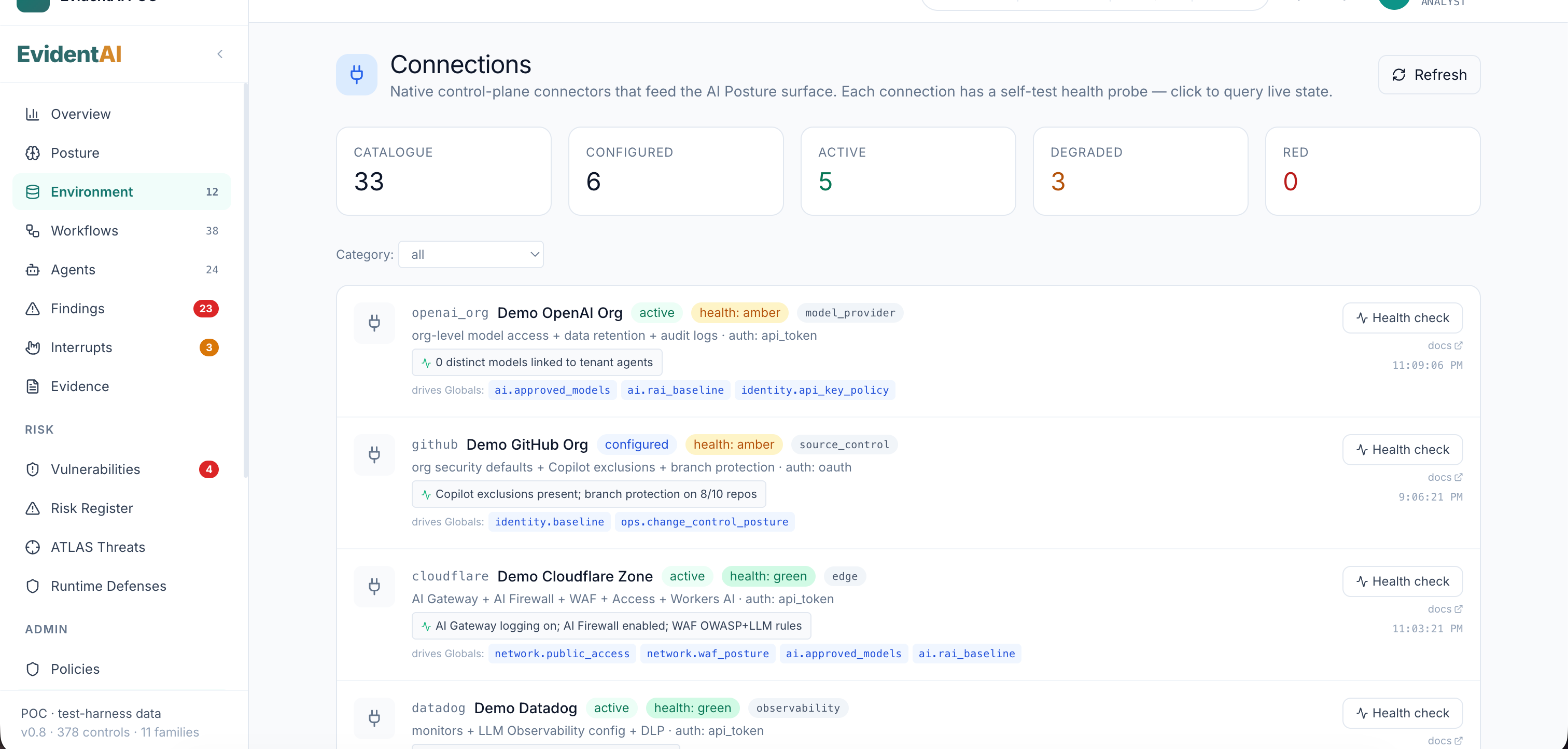
Which tools an agent may use, which model version it carries, what instructions it was given, and where data may leave. Each check binds to the same control that governs live decisions, so a setup failure and a live failure carry the same control. An assessor is never reconciling two systems.
Noncompliant setup is blocked before it ships. Drift detection compares what was approved against what is actually running and raises a finding when they diverge.
Evaluation
Continuous evaluation
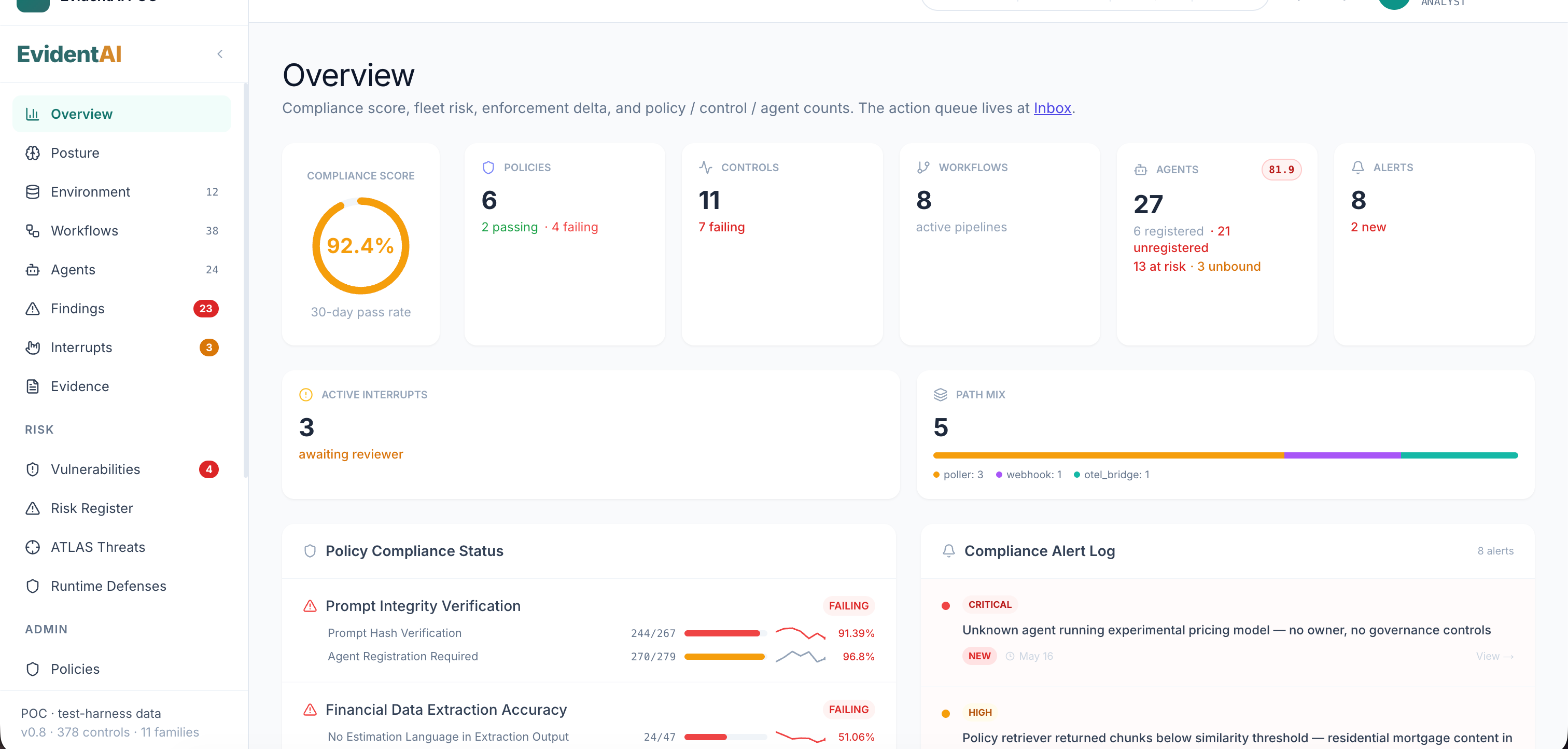
Policies bind to workflows and are evaluated on every decision. Each verdict is written against the active policy set and does not change once written.
Violations surface as they happen with the decision context attached, so nobody goes back for it later.
app.evidentai · /overview
Enforcement
Runtime enforcement
Your system asks, EvidentAI answers, your system acts. Allow, notify, route, escalate — the verdict comes back before the action completes.
We are not in your inference path. Nothing routes through us and nothing waits on us. If EvidentAI is unreachable, your pipeline does not notice.
Every enforcement decision carries the control that fired. An examiner can see what was stopped and why.
app.evidentai · /connections
Security
Vulnerability monitoring
An AI vulnerability catalog ships with the product. Occurrences are drawn from live findings and ranked by severity. Each one maps to , so security teams read AI risk in a language they already use.
Coverage views show which defenses are registered and where the gaps are. Same controls, same verdicts as everything else.
Human oversight
Human-in-the-loop enforcement
When policy requires a person, the action stops. It lands in the sign-off queue with the decision context already attached. The reviewer approves or sends it back, and what they decide becomes part of the verdict.
Oversight is a governed step here. No screenshots in shared drives. Every review is attributable.
Workflows
Workflow-based governance
Governance attaches to the workflow. Register one and EvidentAI governs everything inside it: which agents acted, what policy applied, where a human signed off.
The workflow is shown as it actually executes, which is usually not the diagram.
Evidence
Evidence packages & framework mapping
Verdicts and sign-offs compile into packages built for examiner review. Controls map to the frameworks assessors already use, and SR 11-7 among them.
PII shielding and DSAR handling run on those same controls.
Next step
See it against real workflows.
Founding design partners are being recruited in banking, insurance, and healthcare. Open the live demo, or book a call.