AI GOVERNANCE FOR REGULATED WORKFLOWS
Your AI systems are already making decisions.
EvidentAI governs the decision.
The architecture is documented, the models are approved, the guardrails are defined, and the logs are being collected. But when someone asks how this application made this decision, finding the answer is rarely straightforward.
The evidence is usually spread across multiple agents and systems. That means someone has to reconstruct what happened by pulling together logs and events from different places.
Every framework, one control
Teams rarely standardize on a single framework.
Some teams build on established frameworks, others assemble their own scaffolding from scratch. Each carries its own vocabulary—chains and tools in one place, crews and tasks in another, and in custom applications whatever conventions the team happened to settle on.
Underneath the naming, the governing question does not vary. A decision was made, and policy either permitted it or did not.
That is the layer EvidentAI governs. Control is defined once and holds across the estate, instead of being rebuilt for each framework.
The map
Many regimes. Three obligations.
Statutes change faster than anyone can rebuild against them. Colorado repealed its own AI act in May 2026 and wrote a new one. Underneath, what a regulator asks a deployer to produce has stayed remarkably steady. Pick any node to read what it requires.
Regime
What it asks for
The control that answers it
One control layer, not one per statute. When a regime is rewritten, the obligation usually survives the rewrite.
The problem
Workflow reality
AI agents now handle parts of workflows that used to be done entirely by humans. The challenge is that those decisions happen across multiple systems, so governance has to keep up in real time.
What it does
What EvidentAI actually does.
Agents already in production are governed as they are. Setup is judged against policy before the first decision. Every decision after that is judged as it lands. The output is what an examiner asks for.
Policy runs on every decision
Policy is evaluated on every action an agent takes, the moment it happens. A violation becomes a finding the same minute. Risky actions stop and wait for a named reviewer.
The verdict is the record
Policy decides, and the decision is sealed with the inputs, the documents retrieved, and the control that fired. Edited afterwards, the record fails verification.
The whole workflow
Register a workflow once. From then on it is governed step by step, human approvals included.
Known AI attacks
A vulnerability catalog mapped to shows which known techniques each agent is exposed to. Prompt injection is one. Either a defense is registered against it or the gap is visible.
Inside the platform
Agent registry
Every registered agent, model, and tool, each with a named owner.
Workflow governance
Register once. Governance attaches from there.
Human sign-off queue
Risky actions wait for a named reviewer.
AI vulnerability catalog
Known weaknesses matched to registered agents and ranked by severity, with occurrences drawn from live findings.
MITRE ATLAS matrix
AI threats in the language security teams already read.
Evidence packages
Findings and sign-offs compiled for examiner review.
Policy explorer
Policies and controls, bound to what they govern.
NIST AI RMF mapping
Ships with the product.
Bias cohort definitions
Cohorts and their statistical tests get defined per workflow. Scoring starts once decision volume builds.
PII shield
Personal data caught and redacted before it leaves.
DSAR workflow
Privacy requests tracked through to fulfillment, with evidence.
Token budgets
AI spend metered per workflow, with hard caps.
Everything else
Workflows & agents
The same agent carries different obligations in different workflows.
That's typical in customer workflows. The same agent may be allowed to approve in one workflow and only recommend in another, depending on the rules, controls, and risk profile of the process. Tools that govern the agent alone do not see the difference.
Agent
Intake & draft
The agent does the work it was built for.
Tool call
Retrieval & state
Inputs and retrieved documents, name and version, become part of the decision at the moment of inference. Still there when someone goes back for it.
Policy gate
Judged against policy
Every decision ends in a verdict. Allowed, flagged, or held.
Human checkpoint
Sign-off queue
Risky actions wait until a person decides. Who decided and what was in front of them becomes part of the verdict.
Evidence
Sealed
The decision closes sealed, with the control that governed it named on it. Open it whenever.
How this is different
Where this sits.
Posture dashboards can say a control is passing today. GRC platforms can file the evidence afterwards. Neither is present when the decision happens. EvidentAI sits exactly there, judging each decision against policy as it is made. When an examiner asks for the decision and the control behind it, both come from that one place.
PROOF
The control is on the record
Observability shows what happened. It cannot show what was supposed to happen. EvidentAI names the control that governed each decision and proves the verdict has not moved since it was written.
UNIT
The workflow is the unit
Model-level controls never see the decision. Posture checks stop at the agent boundary. Policy placed on the workflow governs the whole path. Every step.
FEED
It feeds the GRC
The control library already lives in OneTrust or Archer. EvidentAI maps to it once, then feeds AI evidence into the system assessors already accept.
What it doesn't do
Three things EvidentAI does not claim.
EvidentAI does not make a policy good. A policy that permits something it should not will be enforced as written, and the examiner will still have a problem. Governance tooling cannot fix a bad control. It can only take away the pretense that the control ran.
Bias scoring does nothing on day one. Cohorts and their tests are defined up front. The numbers mean nothing until decision volume builds.
And it does not replace the GRC. The control library stays where it is. EvidentAI maps to it and feeds it. Any vendor claiming an AI governance product also replaces Archer has a migration story worth asking about.
Who it's for
Banks, insurers, health systems.
Places where an AI decision ends up in an exam file, and where an AI policy document doesn't satisfy anyone anymore.
FS · HC
Financial services & healthcare
Banks, insurers, asset managers, and health systems putting LLMs into decisions that get examined.
GRC · RISK
GRC & risk leaders
The people who have to show an examiner that a decision was governed, with the control named.
EXAM
Exam pressure
Model risk frameworks built for tabular models don't transfer to inference. EU AI Act high-risk obligations land soon.
In production
What customers say.

We build AI into clinical workflows, so every decision the software touches has to be explainable long after the appointment ends. EvidentAI keeps that record as the work happens. When a regulator or a practice asks what the model saw and why, we show them instead of reconstructing it.
Field notes
What changed, and what I make of it.
-
27 July 2026 EU
The EU moved the deadline. One piece landed anyway.
The Digital Omnibus on AI entered into force six days before the original high-risk deadline. Obligations for standalone high-risk systems now fall on 2 December 2027, and 2 August 2028 for AI inside regulated products.
My read. The headline said delay, so a lot of teams stopped reading there. The Article 50 transparency duties were not deferred. They applied on 2 August, last month. A deferral is not a repeal. It is a longer runway to the same landing, and one wheel is already down.
-
14 May 2026 Colorado
Colorado repealed its own AI act and kept the hard part.
A federal court paused enforcement in April. Weeks later the legislature replaced SB 24-205 with SB 26-189, effective 1 January 2027. High-risk AI system is gone. Automated decision-making technology that materially influences a consequential decision took its place.
My read. Read what survived the rewrite. The narrower law still gives a deployer 30 days to explain an adverse outcome and a duty to offer meaningful human review. That is not a documentation exercise. Nobody can write it in advance. Either the system recorded why, or a person reconstructs it against a clock.
-
1 January 2026 Health
CMS put human review inside a payment condition.
The WISeR model runs to 2031 across six states, applying AI to prior authorization for selected Medicare services. A qualified clinician has to make any decision that is not an approval. The model does not get to deny.
My read. Governance teams have argued for human oversight as good practice for years. Here it is a condition of getting paid. That changes the question an auditor asks. Not whether a policy required review, but whether the reviewer actually saw what the model produced.
-
Ongoing Federal
The states are legislating. The federal government is litigating.
States had enacted 109 AI laws by 1 July 2026. Meanwhile a Department of Justice task force stood up in January 2026 to challenge state AI laws in federal court, under an executive order signed the previous December.
My read. I do not know how that resolves, and anyone who says they do is guessing. What I am sure of is that waiting is not a strategy. Build to a statute and one ruling can send you back to the start. Build to the obligation and the statute can change underneath you at no cost.
Product preview
From policy verdict to sealed evidence.
app.evidentai · /overview
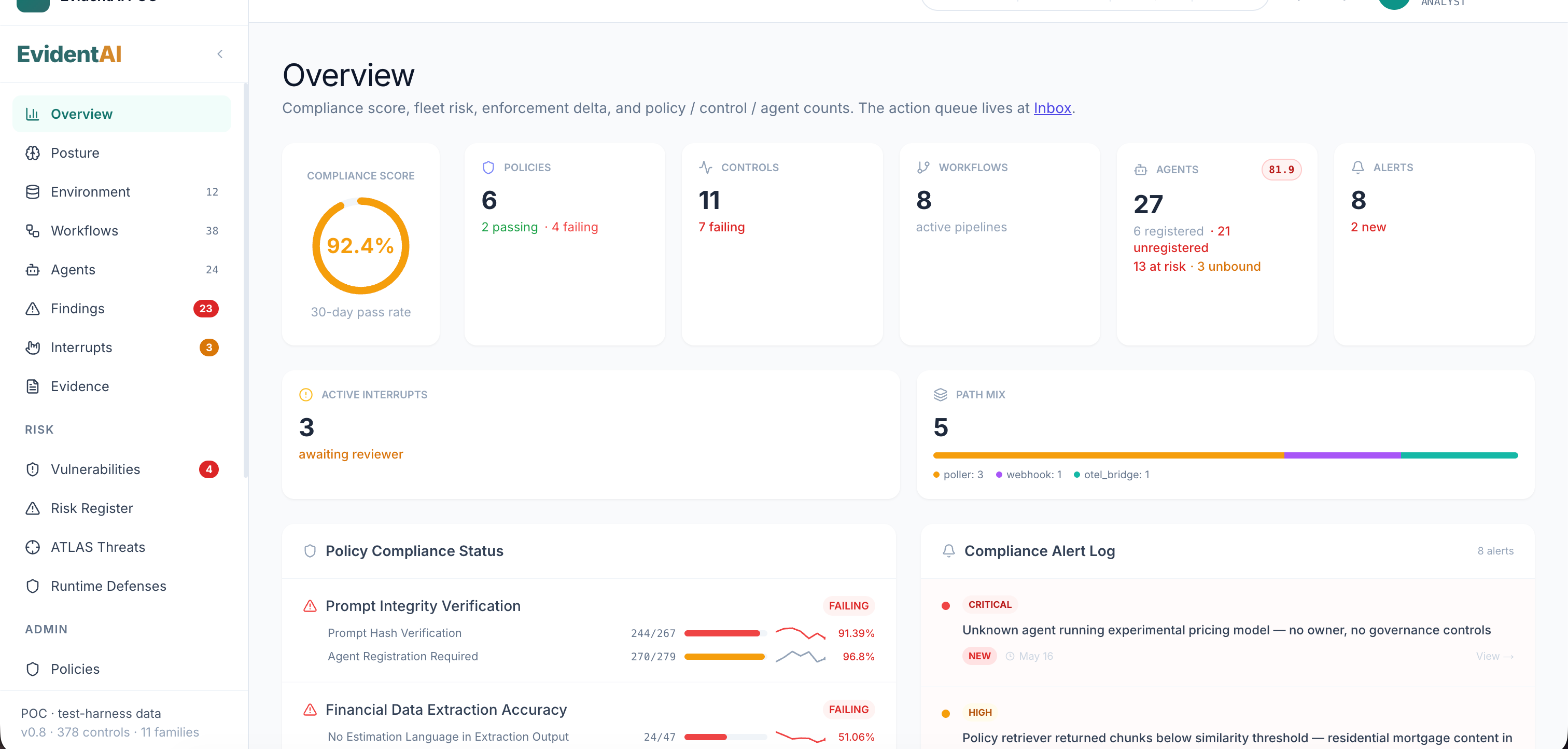
OverviewCompliance score, fleet risk and the action queue on one screen.
app.evidentai · /connections
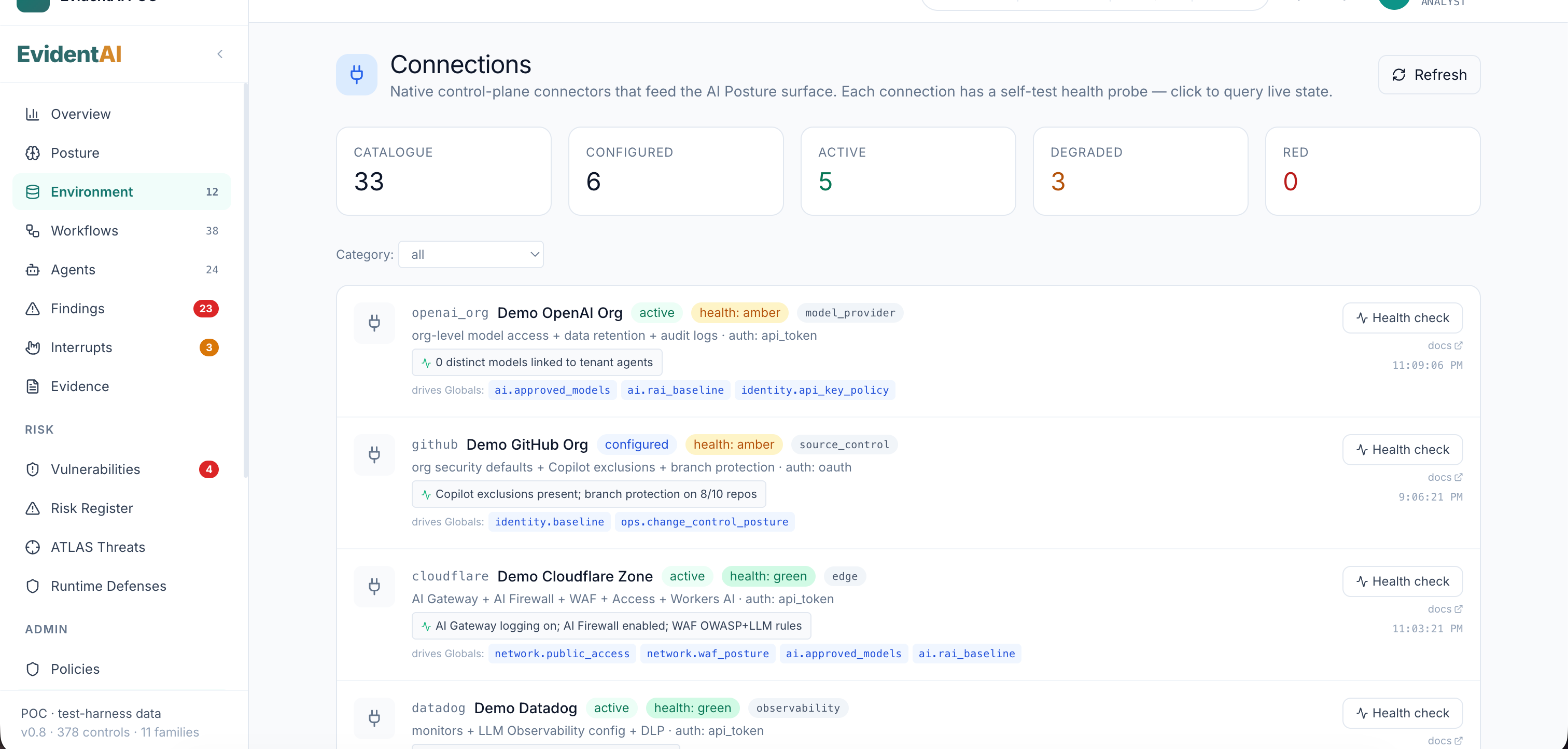
EnvironmentLive posture across every AI connector and control plane.
Get in touch
Talk to the founders.
A few founding design partner slots are open. Partners get the founders' numbers and a real say in what gets built. Terms are preferred for the first cohort. To talk before seeing anything, book a call. Remote or in person.
Or email directly at contactus@evidentai.app